
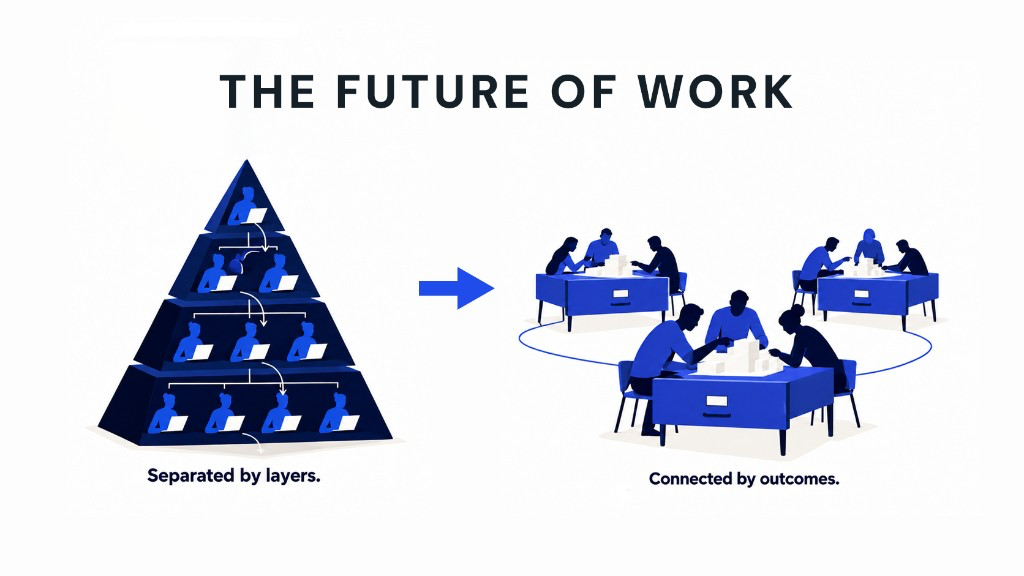
The Org Chart Is 2000 Years Old. The Pod Replaces It.
The limit on how much one person can coordinate hasn't moved. What changed is that information no longer needs a person to carry it.

For two thousand years, we have organized human work the same way: a pyramid, one person at the top, widening layers beneath, each layer reporting to the one above it. We treat this as the natural shape of an organization, the way water is the natural shape of a river. It is not natural. It was invented, for a specific reason, to solve a specific problem, and the problem it solved is disappearing.
The pyramid is an information-routing protocol. The Roman army worked out that one leader can manage somewhere between three and eight people before he loses track of them, so they built layers to route around that limit: eight soldiers shared a tent under a leader, and ten of those groups reported to a centurion. The Prussians turned it into staff doctrine, the railroads adopted it to run trains across a continent, and the corporation inherited it whole. Every org chart you have ever seen is a Roman military formation wearing a suit.
Notice what the layers are actually for. They are not there to add wisdom; they are there to move information. A manager aggregates what is happening below him, relays decisions from above, and keeps the people beside him aligned, and every layer that moves information also delays it and distorts it. By the time a signal from a customer reaches someone with the authority to act on it, it has passed through so many interpreters that it barely resembles what the customer said.
We accepted this cost because there was no alternative. Human beings have a fixed bandwidth for holding other people's work in their heads, and organizations produce more information than any one head can hold. The pyramid was the only coordination technology we had. So the question worth asking is not whether hierarchy is good or bad. The question is what you would build if the information no longer had to travel through a person to move.
A different shape
The answer people keep arriving at, independently, in industries that have nothing to do with each other, is the pod.
A pod is a small, self-contained unit that owns an outcome end to end and plugs into shared infrastructure through a clean interface. That is the whole idea, and everything else is detail. What makes it interesting is that the word arrived at this meaning by traveling through three physical worlds first, and it kept a useful instinct from each.
In nature, a pod is a seed casing, a sealed husk that holds everything a few seeds need to germinate, which gives us self-containment. In the ocean, a pod is a small band of whales, usually somewhere between two and thirty, related or bonded, that travels together and protects each other, which gives us cohesion. In aviation, a pod is the streamlined housing bolted to the outside of an aircraft to hold an engine. Engineers call it a podded engine, and they mount it on a strut so it can be maintained or swapped without redesigning the plane, which gives us modularity.
The organizational pod inherits all three at once. It is sealed, so the work that must stay together stays together; cohesive, so the unit moves as one; modular, so you can add or replace a unit without rebuilding the whole. When someone tells you their company runs on pods, that is what they are reaching for, whether they can name it or not.
The same move, five times
Once you see the shape, you find it everywhere, always solving the same problem.
In software, the pod became the atom of modern infrastructure. When Google built Kubernetes to run applications across thousands of machines, they made the pod the smallest unit you can deploy: a pod holds the containers that must live together to function, sharing the same address and the same local resources, always placed on the same machine. The design principle is exact. Put together the things that must coordinate, so the coordination never has to travel, and treat each pod as disposable at the unit level, so that if one dies the system replaces it without disturbing the rest.
In finance, the pod became the dominant structure in the most competitive corner of capitalism. After a near-fatal loss in 2008, Ken Griffin rebuilt Citadel as what observers called a nesting doll of mini-hedge funds. Capital gets distributed across dozens of small teams, each running its own book, each covering one strategy, each judged almost entirely on its own numbers. The firm provides the shared spine, the technology, the risk systems, the operations, and the pods trade with real autonomy. The model has worked well enough that the single-manager fund it competes with has been losing ground to it for most of a decade.
In product organizations, the pod became the answer to the handoff. The old structure siloed people by function, so designers waited on engineers and engineers waited on QA, and every handoff between them was a chance for the work to be misunderstood and sent back. The pod folds all the functions into one small unit that owns the feature from idea to shipped. Spotify made the model famous, and Google, HubSpot, and half the industry followed.
In agencies and engineering firms, the pod became the way to scale without the layers. Instead of departments passing a client between them, a small cross-functional team owns a set of clients or a project from start to finish. The pitch is always the same three words: no silos, no handoffs, no diluted accountability.
Five industries, no contact between them, arriving at the same instinct: take the people who must coordinate, put them in one small unit that owns the result, and stop routing the information up a chain when it can stay where the work is.
Why now
The pod is old. What changed is the ground underneath it.
For most of history the pyramid held because the coordinating layer did real work. Someone had to carry context between the people who could not carry it themselves. That justification is thinning. As the tools that move and hold information get better, the layer whose only job was to route it becomes harder to defend, and the small self-contained unit stops looking like a nice idea and starts looking like the obvious one.
Jack Dorsey and the investor Roelof Botha put the point sharply in a 2026 essay arguing that the org chart itself is obsolete. Their claim is not that hierarchy was ever stupid, but that hierarchy existed to route information, and information can now be routed by systems faster and less lossy than a layer of managers. They trace the same genealogy, Rome to Prussia to the railroads, and conclude that the coordinating layer can be thinned to almost nothing: deep specialists do the work, owners take a problem and drive it end to end with the authority to pull whatever they need, and everyone who existed only to move information up and down is no longer required. You do not have to accept their whole prescription to see that they have named the thing. The reason flat organizations kept failing for a century was never that flatness is a bad idea; it was that flatness removed the coordinating layer without replacing what it did. Now there is something to replace it, and the pyramid loses the one justification it ever had.
Where it breaks
A model this popular attracts more belief than it has earned, so it is worth being clear about how the pod fails, because it does fail, and the failures are predictable.
The first is the irony at the center of the whole idea. The pod is sold as the cure for silos, and left alone it becomes one. A unit that owns its outcome and needs no one else will, over time, build its own way of doing things, its own standards, its own small culture, and stop talking to the units beside it. You set out to remove the walls between functions and you end up with walls between pods. The handling is not complicated, but it is not optional either. Pods need a thin connective layer that the pod model does not provide on its own: shared standards, regular contact between the people who lead them, and a deliberate way for a specialist in one pod to stay in touch with specialists like them elsewhere, or their skills quietly narrow to whatever their pod happens to need.
The second is load. Real work does not distribute itself evenly. One pod gets a client who keeps expanding while another loses one, and now you have a unit drowning and a unit idle, with no shared queue to move the work between them. The fix is to keep a way to rebalance across pods, so autonomy does not harden into isolation the moment demand shifts.
The third failure is the deepest, and it comes from finance, where the pod model has run longest and at the highest stakes. The whole promise of a pod system is that the units are independent, so a problem in one does not become a problem in all. Hedge funds bet enormous leverage on exactly that independence, and periods of market stress keep testing what the independence is actually worth. When the market turns hard, teams that looked separate can turn out to be holding the same positions, built from the same data and the same assumptions, and they reach for the exit at the same moment. What looked like a hundred independent bets behaves, under stress, like one crowded trade. The tight risk controls that make each pod safe on its own can make the whole system move as a single nervous animal.
That last one carries the lesson that matters for everyone else, not just for traders. A pod system is only as resilient as the pods are genuinely independent. If your units look separate but are quietly running on the same inputs, the same playbook, the same few assumptions, then you do not have diversification. You have correlation wearing a costume, and it will take the costume off at the worst possible moment. Independence you can see at the unit level can hide sameness at the level of the whole. The handling is to make the independence real: different context, different judgment, genuine slack between the units, and an honest look at whether your pods are actually thinking apart or just sitting in separate rooms thinking the same thing.
The shape human nature already prefers
Strip away the technology and there is a simpler reason the pod keeps winning: it fits the animal.
The number the Romans discovered, three to eight people under one leader, was not a Roman fact but a human one. We perform best in small groups, holding a handful of relationships in real trust and real context, and past that number the trust thins into administration. The pyramid was built to route around this limit; the pod is built to sit inside it. A pod is the size of a group a human can actually belong to.
This is why the same word came from a band of whales. A pod in the ocean is not an org chart. It is a small number of creatures who travel together, know each other, and protect each other, and it holds together not because someone is enforcing alignment from above but because the members are close enough to stay aligned on their own. That is the quiet claim underneath every version of the model. When the people who must coordinate are close enough, coordination stops being a job someone has to do and becomes a thing that simply happens.
Here is where the newest thinking and the oldest instinct pull in slightly different directions, and the difference is the whole point. Dorsey's answer to the coordination problem is to put intelligence at the center and push people to the edge, letting a model carry the context that a manager used to carry. The pod's answer is the opposite in spirit. It does not route around the human limit or replace it with a system. It respects the limit and builds the unit to fit it. The handoff does not die because a model routes around it. The handoff dies because the people who need to talk are already sitting together.
Both fix the same disease, one with a machine in the middle and the other with a small circle of humans who share enough context, enough language, and enough proximity that the information never has to leave the room. The second is older, it asks for less, and it is closer to how we were built to work in the first place. The pyramid was a workaround for a limit we no longer have to route around. The pod is what the work looks like when you stop working around the limit and start building for it.
This is the model we have built Abet around, because we think the pod is not a trend to watch but a shape worth building on — and worth any company looking at honestly before defaulting to the pyramid one more time.
Share this article