
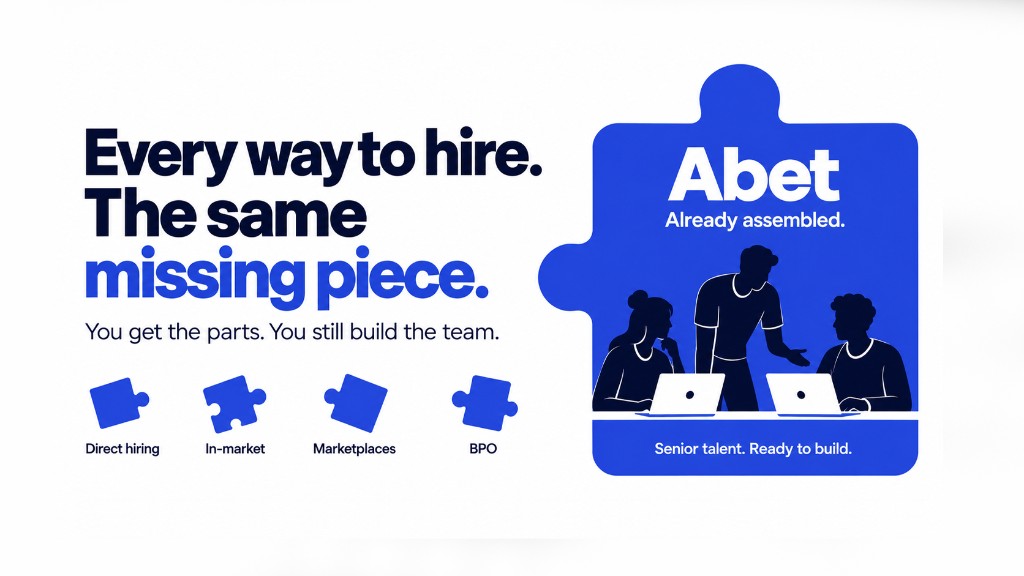
Every Way to Hire Is Broken in the Same Place

I spent a long time looking at every option a growing company has for adding senior engineering capacity, and I kept arriving at the same strange conclusion. It isn't that the options are bad. Each one is genuinely good at something. It's that not one of them solves the specific problem a fast-growing company actually has — and they all fail at the same point, for the same underlying reason.
That gap is why we built Abet. But the gap is worth understanding on its own, whether or not you ever work with us, because naming it changes how you think about the whole decision.
The big problem
A funded startup or a premium engineering agency needs the right senior person, at the right price, at the right time. All three at once. That's the whole problem, and every word in it matters.
The right person means senior, outcome-oriented, top of the market — someone who owns results, not tickets. The right price means a cost you can carry without defunding the growth engine that justifies the hire. The right time means now, because a startup measured in sprints cannot lose a quarter waiting. Miss any one of the three and the other two stop mattering. A brilliant engineer you can't afford is not a solution. A cheap one who arrives in ninety days, after six or seven dead sprints, is not a solution either.
Now watch every existing option fail to deliver all three.
Direct hiring: right person, wrong time, wrong price
Hiring senior engineers yourself is the instinct every good founder has, and for controlling who joins your company, it's the correct one. But the senior people you want already have jobs and are fielding multiple offers, so finding, vetting, and landing one takes around ninety days — six or seven sprints a startup can't spare. And when you find them, they're priced at the top of a scarce market. You've solved the right person and lost the right time and right price in the process.
Hiring in your own market: right person, impossible price
Maybe you decide to pay for it — hire a senior, in-house, in a high-cost market, and get the in-person team you always pictured. If you have deep reserves and certain growth, that's the best version of team-building there is, and you should do it. But for most growing companies, the fully-loaded cost of a senior hire runs a quarter of a million dollars a year and up, and it forces the choice no founder should have to make: the best engineer, or the marketing budget that drives the growth. Right person, at a price that eats the company.
Marketplaces: fast, but they hand you a stranger and walk away
So you try a marketplace — Toptal, Turing, Upwork. Faster, yes. For one person on a short, bounded project, it's the right tool. But they connect you to an individual and then, by design, they're done. Everything else is still yours: setting up the machine, figuring out how you even pay someone across borders, integrating a stranger who's juggling two other clients, and rebuilding it all when they rotate off. You got faster and gave back right person and right time-to-productivity, because a solo contractor is not a team and the setup tax lands entirely on you.
BPO: Optimized for Scale and Cost, but Not Always for Senior Engineering Teams
So you go the other direction — a BPO, the affordability answer most of the world reaches for. And for a call center, an ERP keeps running, tier-one support, it's the correct, proven choice. But the model competes on the lowest hour, which means quality is held to a floor and the people churn — 40 percent and up, every year, because a fractionally better rate always exists somewhere else. Those developers are running three or four engagements at once; you never have their focus, you're managing across a distance you can't see into, and the culture resets to zero every time someone leaves. You got right price and lost right person and everything that makes a team a team.
The gap they all share
Line them up and the pattern is unmistakable. Direct hiring is too slow and too expensive. In-market hiring is unaffordable. Marketplaces sell you a person and leave the assembly to you. BPO sells you the cheapest hour and the churn that comes with it.
Every one of them hands you a fragment and makes you the assembler. A candidate but not the speed. A person but not the team. A low rate but not the quality. You are always left holding the missing pieces and the integration, the infrastructure, the retention, the management, the culture and doing that work yourself is the actual job you were trying to outsource in the first place.
That's the gap. Not one of these models delivers an assembled, senior, affordable team, fast, with the operational scaffolding already handled. The market offers raw materials and calls them solutions.
What we built, and why we built it this way
We didn't start Abet because starting a company is a thing founders do. We started it because that gap is real, we had felt it ourselves, and closing it well felt worth the work, the kind of purpose that gives meaning to the people building it, at every level.
So we borrowed a metaphor from infrastructure. When your traffic spikes, you don't hire a server — you provision compute. You scale the unit of output, not the unit of employment. We applied the same logic to engineering. Instead of selling you a hire to manage or an individual to integrate, Abet provisions a Sovereign Pod: one Lead Architect and two Senior Engineers, already assembled, already a team, embedded directly in your stack — your Slack, your GitHub, your roadmap — with you keeping full control of the architecture.
It's designed to hold all three at once. Right person: the pod is drawn from the top of the market, senior and outcome-owning, not the cheapest hands that clear a floor. Right time: it's provisioned on a 21-day clock, not a 90-day hunt — you replace a four-month hiring cycle with a three-week deployment. Right price: one fixed cost that lets you tap senior capacity without carrying a quarter-million-dollar salary or standing up any infrastructure yourself.
And it dissolves the fragmentation the other models can't. The pod is one cohesive team from one place, sitting together, sharing a culture and a language, on hardware and networks that are provisioned and controlled rather than left to a stranger's home setup. They don't churn off to a competitor for a better rate. They stay, and they compound — getting faster on your specific product every quarter because the context never walks out the door.
Isn't this just staff augmentation?
If you know the market, one comparison should be forming in your mind, and it's the sharpest one. Staff augmentation firms — the ones that place a dedicated engineer inside your team for a monthly rate — are the closest thing to what we do. They don't connect and vanish like a marketplace, and you don't employ the person like a direct hire. It's a fair comparison, and it deserves a straight answer rather than a dodge.
Here's the difference, and it's the whole difference. A staffing firm places individuals. It finds you one good engineer, then another, then a third — each sourced separately, each a stranger to the others, often working remotely from wherever they happen to be. You are still the one who assembles them into a team: aligning their working styles, bridging the gaps between people who've never collaborated, building the culture between them, standing up the infrastructure they run on. The firm hands you qualified parts. The assembly, the hardest and most valuable part — is still your job.
We don't place individuals. We provision a team with a Lead Architect and the two Senior Engineers share a culture, a language, and an office; they arrive as a functioning unit rather than three résumés you have to fuse. The infrastructure is handled, the co-location is built in, and there's a single point of accountability for the pod's output instead of three separate people you individually manage. Staff augmentation gives you better raw materials than a marketplace. It still leaves you as the assembler. The pod is the assembly, done.
The proof, on the record
This isn't a theory we're hoping works. Our first pod deployed to a live client in December 2025 and expanded 66 percent in its first month as the team pulled more scope toward it. Eight months later, it's still shipping. An assembled senior team, embedded in three weeks, still executing most of a year on.
The lesson, whether or not you ever call us
Here's what I'd want you to take from this even if you never send us a word. Stop evaluating your options as if the question is which vendor. The question is which fragment am I willing to be left holding — the speed, the price, the quality, or the assembly. Every model on the market asks you to give one of them up.
The reason the choice feels impossible is that you've been offered raw materials and told they're finished goods. Once you see that, you can at least choose your trade-off deliberately instead of discovering it three sprints in. And if you decide you don't want to give up any of the four — that you want the assembled, senior, affordable team, fast, with the scaffolding handled — then you already understand exactly what we built Abet to be, and why the other models couldn't be it.
Stop recruiting. Start provisioning. Either way, stop mistaking a fragment for the whole.
Share this article